Motion control is a sub-field of automation, in which the position or velocity of machines are controlled using some type of device such as a hydraulic pump, linear actuator, or an electric motor, generally a servo. Motion control is an important part of robotics and CNC machine tools, however it is more complex than in the use of specialized machines, where the kinematics are usually simpler. The latter is often called General Motion Control (GMC). Motion control is widely used in the packaging, printing, textile, semiconductor production, and assembly industries.
Overview:
The basic architecture of a motion control system contains:
A motion controller to generate set points (the desired output or motion profile) and close a position or velocity feedback loop.[1]
A drive or amplifier to transform the control signal from the motion controller into a higher power electrical current or voltage that is presented to the actuator. Newer "intelligent" drives can close the position and velocity loops internally, resulting in much more accurate control.
An actuator such as a hydraulic pump, air cylinder, linear actuator, or electric motor for output motion.
One or more feedback sensors such as optical encoders, resolvers or Hall effect devices to return the position or velocity of the actuator to the motion controller in order to close the position or velocity control loops.
Mechanical components to transform the motion of the actuator into the desired motion, including: gears, shafting, ball screw, belts, linkages, and linear and rotational bearings.
The interface between the motion controller and drives it controls is very critical when coordinated motion is required, as it must provide tight synchronization. Historically the only open interface was an analog signal, until open interfaces were developed that satisfied the requirements of coordinated motion control, the first being SERCOS in 1991 which is now enhanced to SERCOS III. Later interfaces capable of motion control include Profinet IRT, Ethernet Powerlink, and EtherCAT.
Common control functions include:
Velocity control.
Position (point-to-point) control: There are several methods for computing a motion trajectory. These are often based on the velocity profiles of a move such as a triangular profile, trapezoidal profile, or an S-curve profile.
Pressure or Force control.
Electronic gearing (or cam profiling): The position of a slave axis is mathematically linked to the position of a master axis. A good example of this would be in a system where two rotating drums turn at a given ratio to each other. A more advanced case of electronic gearing is electronic camming. With electronic camming, a slave axis follows a profile that is a function of the master position. This profile need not be salted, but it must be an animated function.

Dec 29, 2011
Dec 14, 2011
DC Servo Motor Driver 700 Series

The 700 series is a high performance, cost effective Servo Motor Driver to implement intelligent Motion Control. The driver incorporates an advanced architecture and surface mount technology to achieve an exceptional power density.
Features
- Run DC Servos With Step And Direction
- Control Inputs
- 20 Amp Motor Output
- +18 VDC to +80 VDC Power Supply
- PID Closed Loop Operation
- Quadrature Encoder Feedback
- Anti-Dithering Circuit Keeps Motor Silent
- +5VDC, 50 ma Encoder Supply
- Pulse By Pulse Motor Current Limiting
- 0 to 20 Amp Current Limit Adjust Range
- 25 KHz PWM Frequency
- No Tachometer Feedback Needed
- 250 KHz Max Step Rate
- Latched Fault Protection
- 0C to 70C Operating Temperature
- LED Fault Indicator
- Small Size: 2.5" X 2.5" X 0.82" (63 mm X 63 mm X 21 mm)
- Light: 3.6 Oz (100 gm)
- Anodized Aluminum Package
- Modular 2-Piece Main Connector
For more information please visit:
http://moticont.com/700-series.htm

Motion Control Card 600 Series

This card is an easy-to-use, plug-and-play and cost effective solution for single and multi-axis motion control applications. It may be used as a stand-alone unit or may be commanded by an external device.
This series supports up to 4 axes of motion, 16 TTL / CMOS compatible inputs, 16 TTL / CMOS compatible outputs, 3 analog inputs, and up to five optical encoder inputs. The command port is provided for stand-alone operation.
The powerful programming instructions with more than 120 commands include motion control, system configuration, data flow, program flow commands, 32-bit logical and mathematical operations, and other miscellaneous instructions.
These cards can also be operated using an analog joystick or a trackball with quadrature outputs.
These cards can also be operated using an analog joystick or a trackball with quadrature outputs.
The speed of the motor is proportional to the tilt angle of the joystick or the rotational speed of the trackball.The joystick has three speed selection keys; fast, medium and slow speed.
1) Stand-alone
In this mode, the controller does not need an external device such as a PC to operate. The controller is programmed in a simple programming language. The code is developed, downloaded to the controller, run and saved in the controller's non-volatile memory using the supplied Integrated Development Environment (IDE) software.2) Externally Controlled3) Control Panel
In this mode, the external host such as a PC, micro-controller or PLC sends a series of commands to the controller via the RS-232 serial port. The controller processes and performs the incoming commands and responds with proper messages.
The supplied user friendly Control Panel software allows the user to set-up the module quickly. The operator is able to move the mechanism to different positions by pressing the corresponding buttons of the Control Panel or by using the joystick and/or trackball.
The module can also be operated using an analog joystick or a trackball. The speed of the motor is proportional to the tilt angle of the joystick or the rotational speed of the trackball.
Features
- Plug-and-Play
- Quick and Easy to Install
- Very Compact and Easy to Use
- Low Power Consumption
- Easy Programming Language, No Compiler or Assembler Required
- Programmable, Teachable or Manual Control
- Different Modes of Operation:
- Stand-alone, No PC Required to Operate
- Host Controlled, PLC, C/C++, Visual Basic, LabVIEW™
- Joystick / Trackball Controlled
- Stand-alone, No PC Required to Operate
- Quadrature Encoder Feedback
- Built-in Self Test
- Easy System Setup and Evaluation
- Menu Driven
- Free Software Included
Dedicated Inputs
- Positive and Negative Limit Switches per Axis
- Home Switch per Axis
General Purpose Digital Input / Output
- 16 TTL / CMOS Inputs
- 16 TTL / CMOS Outputs
- Quadrature Signals
General Purpose Analog Input
- 3 Inputs
- 8 Bits of Resolution
Communication Interface
- RS-232 Interface
For more information please visit:
DC and Brushless Servo Motor Driver 500 Series
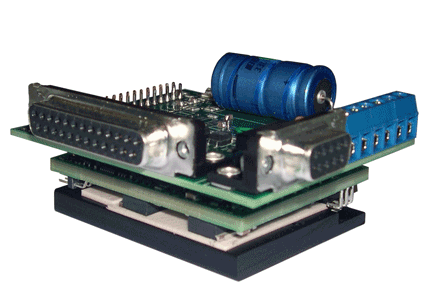
This series of drivers is a high performance, cost effective servo motor driver to implement intelligent motion control. The driver incorporates an advanced architecture and surface mount technology to achieve an exceptional power density.
This series is designed to drive voice coil, brush-type and brushless DC motors at a high switching frequency. They receive step and direction signals or analog signal from motion controller.
Features
http://moticont.com/500-series.htm | Modes of Operation
|
Servo Motor Controller Module 300 Series

The 300 series was designed to allow the rapid implementation of Brushless DC motor or Brush DC Motor solutions in products requiring automation.
The fully intelligent controllers, measuring just 2.25 " x 2.25 ", are require little or no tuning when used with most motors measuring less than 3 " in diameter. (Default PID Values are robust and are stable with most motors). A single 4 wire bus, containing 2 power wires and two communications wires, links up to 16 such BLDC or Brush DC motors in a daisy chain. (See Wiring Diagram). Commands can be issued from any serial terminal program (such as HyperTerminal) or from the EZServo/Stepper Windows application.
The Commands are intuitive and simple. For example the command A10000 will move the Servo motor to Absolute position 10000. (This communications protocol is compatible with devices that use the Cavro DT or OEM protocol. ).
The 300 series is also capable of stand alone operation with no connection to a PC. It can be set to execute a preset string of commands upon power up (i.e. Only power is required in this mode). The Commands include nested loops and execution halt pending a switch closure, which is useful in stand alone applications.
Features
- Plug-and-Play
- 5 Amp BLDC or Brush DC Driver
- Operates from 12V to 40V
- 4 Quadrant Operation.
- On Board EEPROM For User Program storage.
- Stand alone operation with no connection to a PC.
- Execution Halt/Branch pending switch closure.
- Pre-wired for Opto-switch inputs
- Position Velocity and Torque modes.
- Industry standard communications protocol.
- Fully programmable ramps and speeds.
- Quadrature encoder based feedback for position mode.
- Velocity mode possible with only Hall sensors for feedback.
- Switch selectable device address.
- Software selectable max currents.
- 4MHz max encoder frequency.
- Motor outputs fully protected against shorts.
- Two 1 Amp On Off Drivers.
- Optional Step and Direction mode, 4MHz Step Frequency.
- 4 ADC Inputs. Halt / Branch on ADC Value.
- Single 4 wire bus linking up to 16 Stepper/Servo motors.
- RS232, RS485 or USB Based Communications.
For more information please visit:
http://moticont.com/300-series.htm
Motion Control Products 100 Series

This motion control system is stand-alone or externally controlled, easy-to-use, plug-and-play and cost effective solution for motion control applications.
Each system includes the power supplies, controller, the servo motor drivers.
This motion control system supports up to 4 axes of motion, 16 TTL / CMOS inputs, 16 TTL / CMOS outputs, 3 analog inputs, and 4 optical encoder inputs. The command port is provided for stand-alone operation.
1) Stand-alone
In this mode, the controller does not need an external device such as a PC to operate. The controller is programmed in a simple programming language. The code is developed, downloaded to the controller, run and saved in the controller's non-volatile memory using the supplied Integrated Development Environment (IDE) software.2) Externally Controlled3) Control Panel
In this mode, the external host such as a PC, micro-controller or PLC sends a series of commands to the controller via the RS-232 serial port. The controller processes and performs the incoming commands and responds with proper messages.
The supplied user friendly Control Panel software allows the user to set-up the module quickly. The operator is able to move the mechanism to different positions by pressing the corresponding buttons of the Control Panel or by using the joystick and/or trackball.
The system can also be operated using an analog joystick or a trackball. The speed of the motor is proportional to the tilt angle of the joystick or the rotational speed of the trackball.
Features
For more information please visit: - Plug-and-Play
- Quick and Easy to Install
- Very Compact and Easy to Use
- Low Power Consumption, High Speed Capability
- Easy Programming Language, No Compiler or Assembler Required
- Programmable, Teachable or Manual Control
- Different Modes of Operation:
- Stand-alone, No PC Required to Operate
- Host Controlled, PLC, C/C++, Visual Basic, LabVIEW™, MATLAB™
- Joystick / Trackball Controlled
- Stand-alone, No PC Required to Operate
- Built-in Self Test
- Available to Drive DC Servo, Stepper, Three Phase and Voice Coil Motors
- Totally Integrated Solution
- Easy System Setup and Evaluation
- Menu Driven
- Free Software Included
http://moticont.com/100-series.htm
Linear Brushless Ironless Motors

Features
- High Acceleration
- High Speed
- High Accuracy
- Cog Free
- High Repeatability
- Independent Multiple Coil Operation with Overlapping Trajectories
- No Metal-to-Metal Contact, Virtually Maintenance Free
- Modular Magnet Tracks
- Trapezoidal or Sinusoidal Commutation
- Increased throughput, a Function of High Acceleration
- Exceptional Accuracy
- Consistent Repeatability
- Environmentally Friendly
- Exceptionally High Force per Volume
- Light Weight-to-Force Ratio
- Quiet
- Reduced Wear and Friction
- Lower Repair and Maintenance Costs
- High Operating Efficiency
- Unlimited Stroke Length
http://moticont.com/brushless-motor.htm
Subscribe to:
Posts (Atom)